
In 2002, a reclusive Russian genius named Grigori Perelman put an end to more than 100 years of suffering in the mathematical community. He solved the most difficult math problem of the 20th century -the Poincaré Conjecture. Its siren call had lured generations of mathematicians to intellectual graves. It first, its simplicity would seduce them, and they'd become convinced the answer was near. But as years passed, they'd be left with nothing to show for their lives' toil but dead ends. By the time Grigori Perelman proved the Conjecture, the solution was worth $1 million.
THE MAN BEHIND THE MADNESS
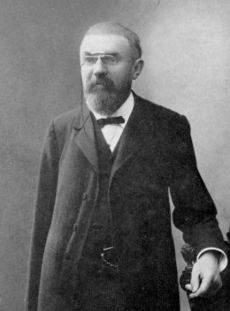
Henri Poincaré
In 1885, all of Europe was talking about Henri Poincaré, a 30-year-old genius who'd mathematically proven why the solar system holds together. When a hole appeared in his calculations, he plugged it up by essentially inventing chaos theory: Kings were tripping over themselves to make him a knight· and Sweden gave him a small fortune in prize money. To this day; Poincare holds the record for the most physics Nobel Prize nominations, though he never actually won one.
But his most legendary achievement was something no one noticed until much, much later. At the turn of the century: Poincaré invented an entirely new field called algebraic topology; and today, it's one of the most complicated and vibrant branches of mathematics. Think of it as a twisted version of geometry, in which shapes stretch, bend, and fold inside out. Poincaré's goal was to classify objects by identifying their basic form, much the same way botanists classify new species of plants. In the process of creating topology, Poincaré tossed out a conjecture that seemed to be true. It was a side note to a larger problem, and he figured he'd work out the details later. Little did he know; his side note would become one of the greatest challenges in the mathematical world.
THE VICTIMS
Poincaré's conjecture seemed simple enough. It claimed that any object without a loop is essentially a sphere. Think of a knife made out of Play-Doh. Without punching a hole in it or closing a loop, can you squish it into a ball? Yes, of course. Now picture a pair of Play-Doh scissors. No matter how hard you try, you can't crush it into a ball without closing up the finger holes. It's impossible. Poincare believed that objects like the knife were related to spheres, while objects with holes and loops in them were not...............
The Quest to Solve the Hardest Math Problem in Historyhttp://www.neatorama.com/2011/11/25/the-quest-to-solve-the-hardest-math-problem-in-history-and-the-minds-that-were-lost-along-the-way/


No comments:
Post a Comment